
At the entry to the small medieval village of Catus, France, there is an ancient stone bridge across the Vert river called the
Pont Garigliano, named after a river in Italy. On one wall of the bridge there is a plaque inscribed with the names Bayard, 1503 and CEFI, 1944. These two dates commemorate two significant battles along the river Garilgiano in Italy.

In WWII some fierce fighting took place between the Allied forces and the Germans around Monte Casino from November 1943 to May 1944 during the Allied advance on Rome. In the fourth and last major battle of Monte Casino, codenamed
Operation Diadem, the French Expeditionary Corps in Italy (CEFI,
Corps Expéditionaire Français en Italie) under General Alphonse Juin crossed the river Garigliano after some fierce fighting, pushing the Germans back and thus paving the way for the capture of the heights of Monte Casino and the Allied march on Rome. A number of young men from Catus took part in this battle and succeeded in getting the local council to commemorate their participation by erecting the plaque and naming the bridge the Pont Garigliano. A bridge across the Seine in Paris is also called Pont Garigliano to commemorate this battle.
In Catus it was decided to include the name of the
Chevalier de Bayard, a medieval French knight. Pierre Terrail, the Seigneur de Bayard, often referred to as "the knight without fear and beyond reproach" (
le chevalier sans peur et sans reproche), had a reputation for courage, daring and bravery and his fame spread to many parts of medieval Europe. It is said that in 1503 he single-handedly defended a key bridge across the Garigliano against 200 Spaniards and in so doing prevented the complete destruction of the French army. An interesting account of the life of Bayard and of the battle can be found in
Bayard by Christopher Hare.
 Opening ceremony of the refurbished halle.
 Crowds at the opening ceremony in the centre of Catus.
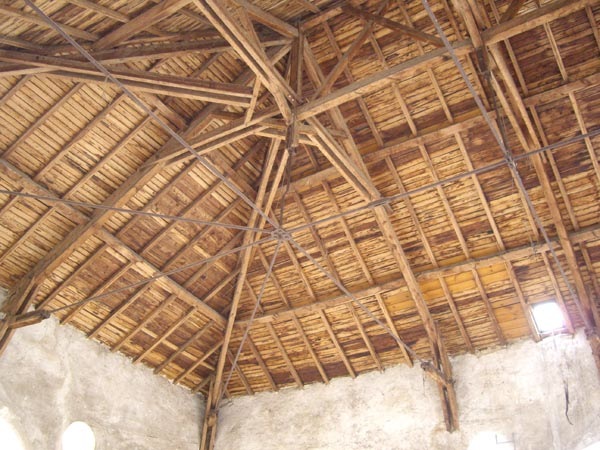 The magnificent wooden ceiling.
 At the entry to the small medieval village of Catus, France, there is an ancient stone bridge across the Vert river called the
  In WWII some fierce fighting took place between the Allied forces and the Germans around Monte Casino from November 1943 to May 1944 during the Allied advance on Rome. In the fourth and last major battle of Monte Casino, codenamed Operation Diadem, the French Expeditionary Corps in Italy (CEFI, Corps Expéditionaire Français en Italie) under General Alphonse Juin crossed the river Garigliano after some fierce fighting, pushing the Germans back and thus paving the way for the capture of the heights of Monte Casino and the Allied march on Rome. A number of young men from Catus took part in this battle and succeeded in getting the local council to commemorate their participation by erecting the plaque and naming the bridge the Pont Garigliano. A bridge across the Seine in Paris is also called Pont Garigliano to commemorate this battle.
  There is a legend that the medieval village of Catus, in southwest France, derives its name from a large cat that roamed the area in the early middle ages. The story goes that the cat had a lair somewhere to the north of the village and used to terrorise the villagers so much so that the local lord offered his daughter's hand in marriage and half his domain to anyone who could get rid of this menace. A young, handsome, bold and courageous knight presented himself for the challenge. He was given a magnificent horse and arms to carry out the task. When the knight approached the lair of the large cat it jumped at him and the knight thrust his lance up to the hilt in the cat's body. He returned triumphantly with his trophy to the lord's castle and claimed his prize. It is said that from this time the village was called Catus - meaning cat in Latin.


